

How to Renew Patriotic Pride by Integrating Progressive Shame
As our Founders understood, the ongoing viability of the American Republic depends on the enduring patriotism of its citizenry. And for most of our history, Americans have generally exhibited strong patriotism. Who can forget Sullivan Ballou’s famous Civil War letter to his wife in which he wrote: “… my love of Country comes over me like a strong wind and bears me irresistibly on with all these chains to the battlefield.” Yet while the majority of Americans continue to love their country, despite its faults, within progressive culture over the last several decades not only has patriotism been declining, there has arisen in its place what can perhaps best be identified as “reverse patriotism.” As liberal political commentator Yascha Mounk recently observed:
“For far too many progressives and leftists, their founding commitment is not to some principle or aspiration for the world. It is to believing that their own countries and societies are at the root of profound evil. This creates in their minds a simple demonology: Anybody who is on “our side” must be bad and anybody who is on the “other side” is presumptively good. As Orwell said about some of the intellectuals of his day, their “real though unacknowledged motive appears to be hatred of western democracy and admiration for totalitarianism.”
For most of those on the right, the standard trope is to unequivocally condemn progressives for the sin of hating America. My position is more nuanced. I’m a registered Democrat, but I’m also a first-generation American. My immigrant parents endowed me with a permanent sense of gratitude for our nation that no political grievance can erase. I’m therefore very concerned about the corrosive effects of reverse patriotism. However, I think simply condemning it is the wrong strategy.
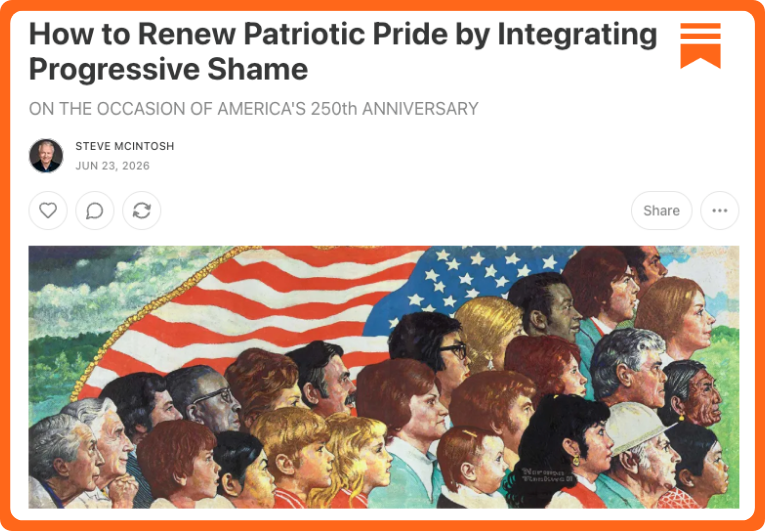
On the occasion of America’s 250th anniversary, in response to the rise of progressive anti-Americanism, this article proposes an enlarged form of inclusive patriotism, one that can harmonize and integrate Americans’ conflicting sentiments of pride and shame.
UNDERSTANDING THE PASSION OF REVERSE PATRIOTISM
Like old-fashioned traditional patriotism, reverse patriotism nurtures people’s sense of identity, creating strong loyalties to its “cause.” In the same way that patriotic pride provides a basis for cultural belonging, a collective feeling of national shame builds similar kinds of solidarity among those who embrace reverse patriotism. Given that there are many good reasons to be ashamed of America’s historical misdeeds, as well as its present injustices, reverse patriotism cannot be dismissed as simply bad faith or historical ignorance. Although unwavering anti-Americanism is an exceedingly one-sided view, the identity-providing passions that animate reverse patriotism point to the conclusion that this deeply ingrained political stance is something we cannot easily dismiss.
Contemporary advocates of national patriotism often attempt to counter anti-Americanism by arguing that America’s good outweighs its bad. These voices of reason, however, cannot effectively reduce the hate that many progressives now feel for America because these moderates fail to reckon with the larger currents of history that have given rise to reverse patriotism in the first place. In order to stem the inevitable social decay that follows from reverse patriotism, we need to create a more inclusive cultural whole in which the valid criticisms we deserve can become better integrated with the meaningful civilizational advances we have achieved.
In emotional terms, this cultural move of integration entails holding our pride and shame in creative tension. When sufficiently integrated, traditional pride and progressive shame can maximize the value-creating capacity of each of these respective sentiments. Generally speaking, pride creates value by motivating us to preserve what’s right, and shame creates value by motivating us to fix what’s wrong. These emotional forces are the wellspring of political will. Yet as long as these polarized loyalties continue to be seen as mutually exclusive, as they are for many Americans today, the political will we need to respond to our contemporary challenges will continue to be thwarted. To create a shared cultural space in which constructive forms of both pride and shame can challenge and support each other by turns, we need to better recognize the forces of historical development that are driving the culture war and destroying our collective solidarity and national unity.
RECOGNIZING THE DIALECTICAL CURRENTS OF HISTORICAL DEVELOPMENT
To see these historical currents plainly and accurately—and to thus understand how pride and shame can be integrated to renew our national comity—we need to take a long view of history. Such a view reveals the unmistakable pattern of dialectical development—the process through which the reconciliation of opposing forces provides an opening for growth into a larger whole. This process is often simplified through the familiar steps of thesis, antithesis, and synthesis. Starting with an unsatisfactory status quo, dialectical growth begins with a rejection or negation of prevailing conditions—the antithesis. This is followed by a synthetic move that reincludes the best of what came before within a larger whole. The synthesis makes progress by partially resolving the tension between the original thesis and its emergent antithesis.
By taking a long-term view of the history of our civilization, this pattern becomes clearly evident. America is a product of the Enlightenment; its national birth corresponds to the rise of what we now call modernity. Modernity originally emerged as a kind of antithesis to Europe’s traditional religious societies. Although the tension-rich dialectical relationship between traditional religious culture and secular modernist culture has characterized American culture throughout its history, over the last sixty years or so, our social conditions have been impacted by a new form of cultural emergence.
In the wake of America’s victory in the Second World War, and the prosperity and social solidarity that followed from it, we enjoyed what is now known as the “liberal consensus.” During this temporary period of relative social unity, the previously prevailing antithetical relationship between religious traditionalism and secular modernism was largely resolved through the rise of a synthesis—a “cultural truce”—that produced uncomplicated patriotism and strong political will. As a result of this liberal consensus, Americans made unprecedented scientific and economic advances, enacted transformative civil rights legislation, and enjoyed strong civic confidence and a shared national purpose.
However, the same dialectical trajectory of development that resulted in the liberal consensus’s “season of synthesis” continued to shape the evolution of American culture. As the shortcomings and internal contradictions of liberal modernity became increasingly apparent to many Americans, the postwar synthesis between modernism and traditionalism began to decay into a more static thesis of itself. America’s middle-class youth, who had already received most of what modernity had to offer, could sense that the American way of life was unsustainable, both socially and environmentally. By 1968, the thesis constituted by the modernist-traditionalist cultural truce began to witness its own transcendence by a new kind of antithesis. The problems of the “establishment,” as it came to be known in the Sixties, gave rise to the countercultural movement, which has since matured into what can now be identified as the “progressive postmodern worldview.”
Commentators who condemn progressives in general, and the subversive influence of reverse patriotism in particular, consistently fail to consider how the progressive postmodern worldview has become the predominant viewpoint within elite American culture. These pundits never seem to ask why progressivism has been so successful at capturing the hearts and minds of many of the leaders of our institutions. In order to effectively counter reverse patriotism, proponents of traditional American patriotism accordingly need to better understand the deep moral appeal of progressivism’s caring values and the larger historical reasons that have led to progressivism’s stance of cultural antithesis to Western civilization.
The strengths of the progressive postmodern worldview include its deep concern for those who have been victimized or left behind, its prioritization of the health of the natural environment, its emphasis on equality, and its affinity for feminine ways of knowing. Yet even though it remains strong, there are signs that the progressive postmodern worldview has reached its cultural zenith. The cresting of this progressive cultural wave can be seen in the fact that progressivism’s abiding pathologies have become increasingly evident to America’s mainstream majority. These pathologies include not only anti-Americanism, but also anti-modernism in general, as well as divisive identity politics, the reduction of all social relations to the narrow dichotomy of oppressor and oppressed, and a political outlook saturated by cynical pessimism and ironic nihilism.
THE COMING POST-POSTMODERN SYNTHESIS
Notwithstanding the corrosive influence of anti-Americanism, the developmental logic of the dialectical course of cultural evolution gives us abundant reasons for hope in our further social progress. In short, progressivism’s antithesis can be seen as a necessary step for our further growth. Recognizing the role of the progressive postmodern antithesis within the larger unfolding of history provides detailed instructions for how we can take this cultural countercurrent in our stride. Simply put, the antithesis makes way for the synthesis. As we now reach the limits of progressivism’s antithesis, we can begin to detect the emergence of America’s next cultural step—a synthesis that can transcend the worst and preserve the best of all three major American worldviews: traditionalism, modernism, and progressive postmodernism. Those who feel threatened by domestic anti-Americanism can thus take heart in the developmental logic which predicts that the progressive antithesis will soon be surpassed by a more inclusive form of synthetic American culture.
This coming synthesis does not yet have a widely agreed-upon label. The most straightforward description is “post-postmodern.” The lexical awkwardness of this term, however, will likely prevent it from becoming the label that sticks. Nevertheless, I like this term because the very morphology of the word post-postmodern performs the synthesizing action of “negating the negation.” Post-postmodernism rejects progressive postmodernism’s totalizing rejection of American society, affirming that despite its crimes, the American nation represents a net-good for humanity.
There are, in fact, many good reasons to take pride in the USA. To name a few: America has led the way in the establishment of liberal values and democracy; it has played a central role in the progress of scientific medicine, and has developed technologies that have benefited humanity immensely; American culture has produced many unique forms of art and music that have enriched the world; since its founding, America has welcomed over 100 million immigrants, and it continues to donate billions annually in foreign aid; America was instrumental in the defeat of fascism and Soviet communism, and the Pax Americana has effectively prevented a war between global powers ever since.
The emerging cultural stance of post-postmodernism, however, does not entail returning to the uncomplicated but one-sided patriotism of the past. Progressivism’s original negation of America’s old cultural establishment can itself only be effectively negated in turn by acknowledging the merits of progressivism’s caring values, and by internalizing its corrective message of shame. In the logic of dialectical development, the synthesis must include, in modified form, the valid critiques and objections of the antithesis.
SYNTHESIZING AMERICAN PRIDE AND SHAME
It is important to affirm that the most productive relationship between pride and shame is not relativistic equipoise. Rather, these polar sentiments should ideally be held together in dynamic tension wherein each can shape and charge the value of the other. Although both patriotism and reverse patriotism attract their share of one-sided extremists, those who aspire to civic virtue would do well to accept the core value of both these outlooks. Indeed, the practice of bringing national pride and shame into a mutually-correcting relationship of challenge and support can help purge the most extreme elements of both sides. Despite the inevitably dialectical course of our development, like a sailboat tacking back and forth against the wind, integrating pride and shame by turns can help us maintain a consistent heading toward a more perfect union.
As a first-generation American, I cannot help but be patriotic. Yet as a post-postmodernist, I also feel a duty to own the shame that is the most appropriate moral response to the misdeeds of American history. As I celebrate America’s 250th birthday, I will therefore endeavor to hold these tension-rich sentiments within a larger mental picture of my personal identity. I won’t let my inherent gratitude for the rewarding life I’ve lived as an American citizen—my natural and instinctive patriotism—be quashed or invalidated. But neither will I avoid the shame that stems from valid grievances about America’s historical offenses, as well as the remaining injustices we are urgently called to remedy.
This is not value relativism; I’m staunchly pro-American and want our nation to thrive and prosper. Yet my reading of the currents of history tells me that the threat of progressive postmodernism’s reverse patriotism can be most effectively countered and culturally transcended by including its most poignant critiques within a larger cultural whole.
For their own psychological well-being, those who feel nothing but shame would do well to allow themselves to take some pride, and those who feel nothing but pride would similarly do well to acknowledge the need for a modicum of national contrition. Without a degree of pride, our shame will eat us alive. And conversely, if we fail to acknowledge a degree of collective shame, our pride will blind us, not only to truth, but to goodness as well. As the Biblical Book of Proverbs teaches, “pride goes before a fall.”
So dear reader, on this Fourth of July, I invite you to take both pride and shame in our country. Let’s resolve to fix what’s wrong—let’s use the motivating power of our shame to demand a better government and a more wise and caring citizenry. And simultaneously, let’s also harness the power of our pride to strengthen our resolve to protect and preserve what’s right about our fragile nation. By thus integrating our national pride and shame, on this symbolic anniversary, we can, with complete sincerity, raise a glass to America the beautiful and give thanks for the United States.